
AI pull request automation is the step beyond autocomplete. Instead of helping a developer type faster, a coding agent can take an approved task, change files, run commands, and open a PR/MR.
That can improve throughput, but only if the automation is designed around reviewable outcomes. Otherwise, teams just get more branches to inspect.

What AI Can Safely Automate
AI agents are strongest when the work is bounded and evidence can be checked.
Good automation targets:
- small bug fixes with reproduction steps
- test additions for known behaviour
- documentation and examples
- simple UI or copy changes
- configuration updates with clear validation
- maintenance chores where the expected diff is predictable
The agent can handle the first-pass implementation, run checks, repair obvious failures, and create the pull request.
What Should Stay Human
Keep humans in charge of:
- which work is approved for automation
- product intent and trade-offs
- architecture decisions
- security-sensitive design
- code ownership and final approval
- merge and release decisions
This is not a conservative afterthought. It is how the workflow stays trusted.
The Pull Request Automation Flow
A strong workflow looks like this:
- Approved work item: a ticket, issue, or task is marked ready.
- Context assembly: repository rules, docs, service relationships, and validation commands are loaded.
- Implementation: the agent makes a bounded change on a branch.
- Validation: required checks run before handoff.
- Repair: the agent fixes validation failures when it can do so inside scope.
- Summary: the PR/MR explains what changed, why, and which checks ran.
- Human review: engineers review and approve through the normal code host.
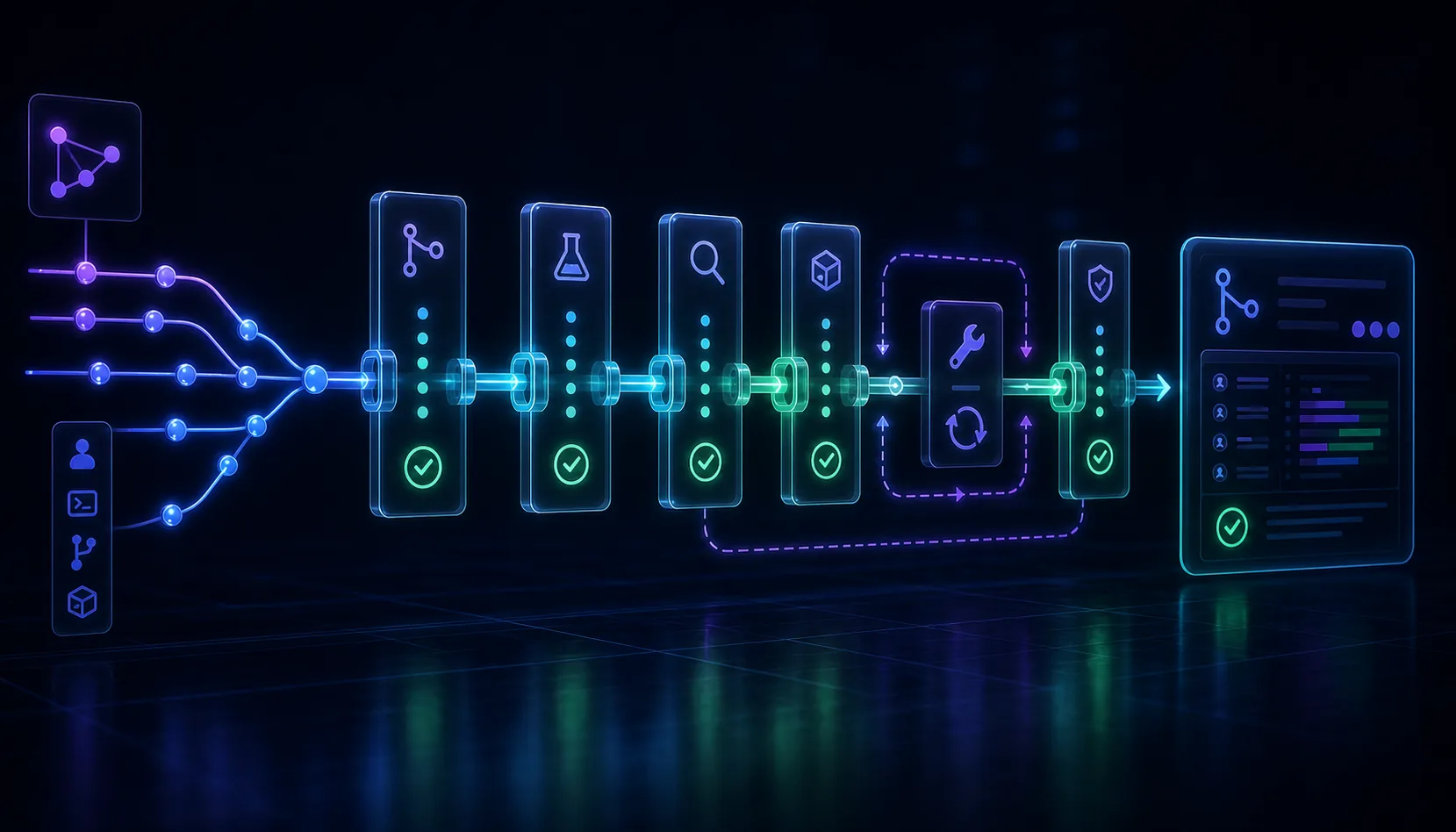
MergeLoom’s ticket-to-code automation follows this pattern across approved work intake, context, validation, audit trails, and PR/MR handoff.
Required PR/MR Contents
Every AI-generated PR/MR should include enough information for reviewers to work quickly.
Required:
- source ticket or issue
- summary of implementation
- acceptance criteria addressed
- commands run and outcomes
- known validation gaps
- files changed and why
- areas where reviewer judgment is needed
Do not make reviewers reverse-engineer the agent’s intent from the diff.
Stop Conditions
Automation needs clear stop conditions. The agent should stop rather than produce a weak PR/MR when:
- the ticket is ambiguous
- the target repository is unclear
- required validation cannot run
- the fix requires broad architecture changes
- the diff grows beyond an agreed threshold
- secrets or sensitive data appear in command output
- tests fail after bounded repair attempts
Stopping with evidence is better than opening a PR/MR that wastes reviewer time.
Branch and Permission Rules
Keep branch rules simple and restrictive.
Use:
- agent-specific branch naming
- no direct writes to protected branches
- PR/MR-only handoff
- repository-scoped tokens
- clear ownership for generated branches
- automatic cleanup for abandoned branches

If the agent can open a PR/MR, it should also be clear who is accountable for reviewing or closing it.
How to Measure PR Automation
Track:
- approved tasks entering the automation queue
- runs that open PRs/MRs
- validation pass rate
- accepted PR/MR rate
- review time
- review rounds
- post-merge defects
- cost per accepted PR/MR
This keeps the workflow honest. More PRs is not the same as more shipped value.
FAQ
Question: Should AI pull request automation replace code review?
Short answer: No. It should reduce setup and cleanup before review, while human engineers keep approval and merge control.
Question: What is the best first use case?
Short answer: Start with small, testable tickets in repositories that already have reliable validation commands.
Question: How does this differ from AI code review?
Short answer: AI code review comments on an existing PR/MR. AI pull request automation creates the branch and review artifact, ideally after validation.