
Code Checkout
Repository access happens on the worker your team operates.
Self Hosted keeps checkout, Context Engine assembly, provider calls, validation, traces, and PR/MR prep inside your boundary while MergeLoom still coordinates the workflow.
Your team controls the worker, AI provider path, secrets, commands, and local evidence. MergeLoom keeps the ticket-to-PR loop moving.
Some repositories, credentials, test environments, and provider paths cannot leave your perimeter. Self Hosted keeps the sensitive work inside your controls.
Repository access happens on the worker your team operates.
CLI login, API keys, and cloud identity stay in your environment.
Tests run where private packages, networks, and secrets already exist.
Deep traces and Code Audit evidence stay on the worker path.
The controller coordinates intake and handoff. Your worker handles the code-facing work, provider calls, validation commands, and local evidence.
The controller provides tenant values and enrollment tokens for the worker install.
Docker Compose or Helm starts the worker components inside your environment.
Use approved CLI agents, private endpoints, Vertex AI, AWS Bedrock, or Azure Foundry.
The worker checks out code, assembles context, calls the provider, runs validation, and prepares branches.
The review request returns to GitHub, GitLab, or Azure Repos.
Ticket Audit, Code Audit, deep traces, and local run state live on the worker side.
Self Hosted lets security and platform teams choose where code, credentials, provider calls, validation, and deep traces live.
The controller coordinates intake and routing. The worker owns code-facing execution.
Use approved CLI agents, OpenAI-compatible endpoints with tool calling, or cloud AI platforms.
Use platform-managed secrets, workload identity, or worker-side provider setup.
Deep run traces and Code Audit evidence stay worker-owned instead of centralized in the cloud controller.
Track worker readiness, live execution, latest run results, and audit history inside the environment where the work runs.
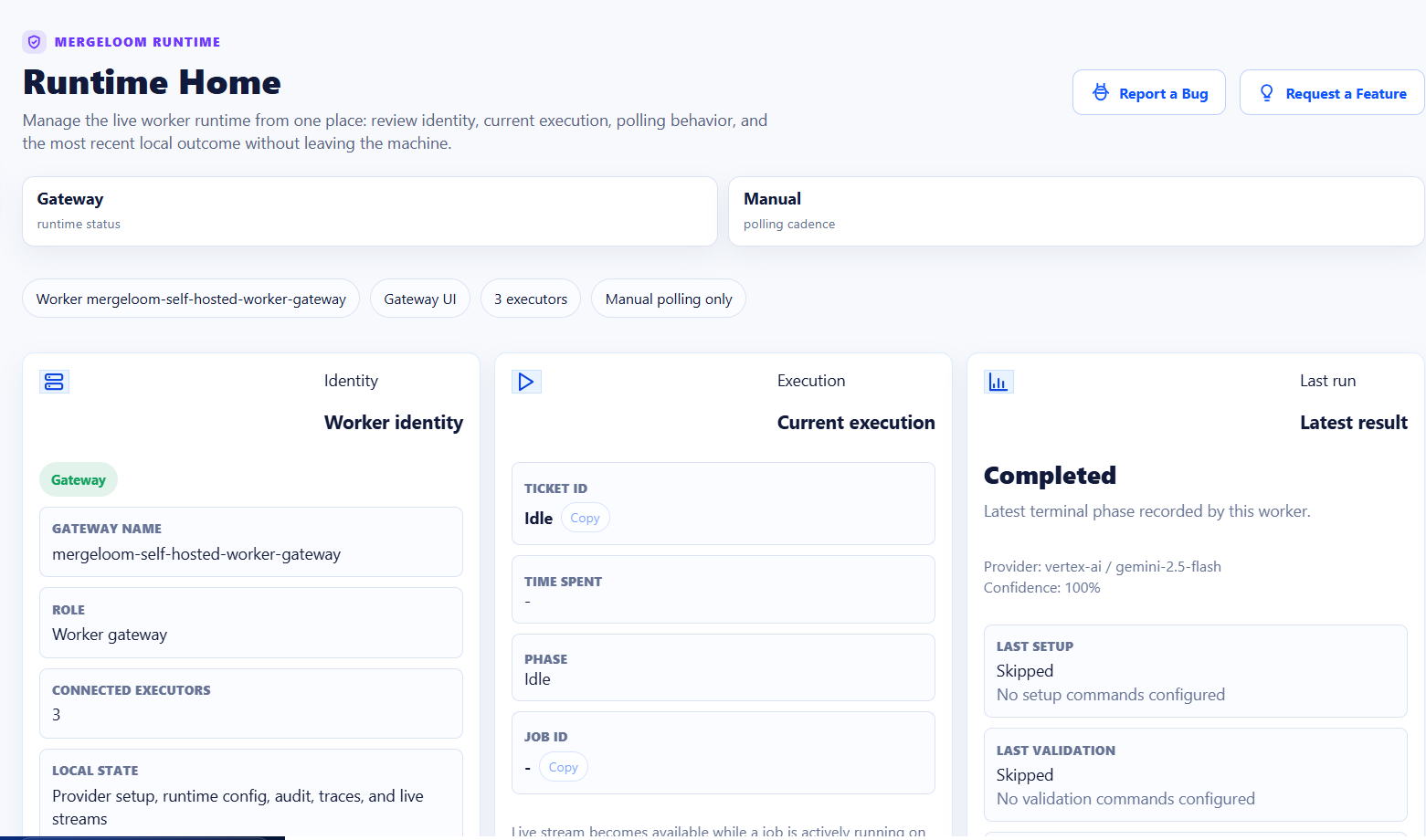
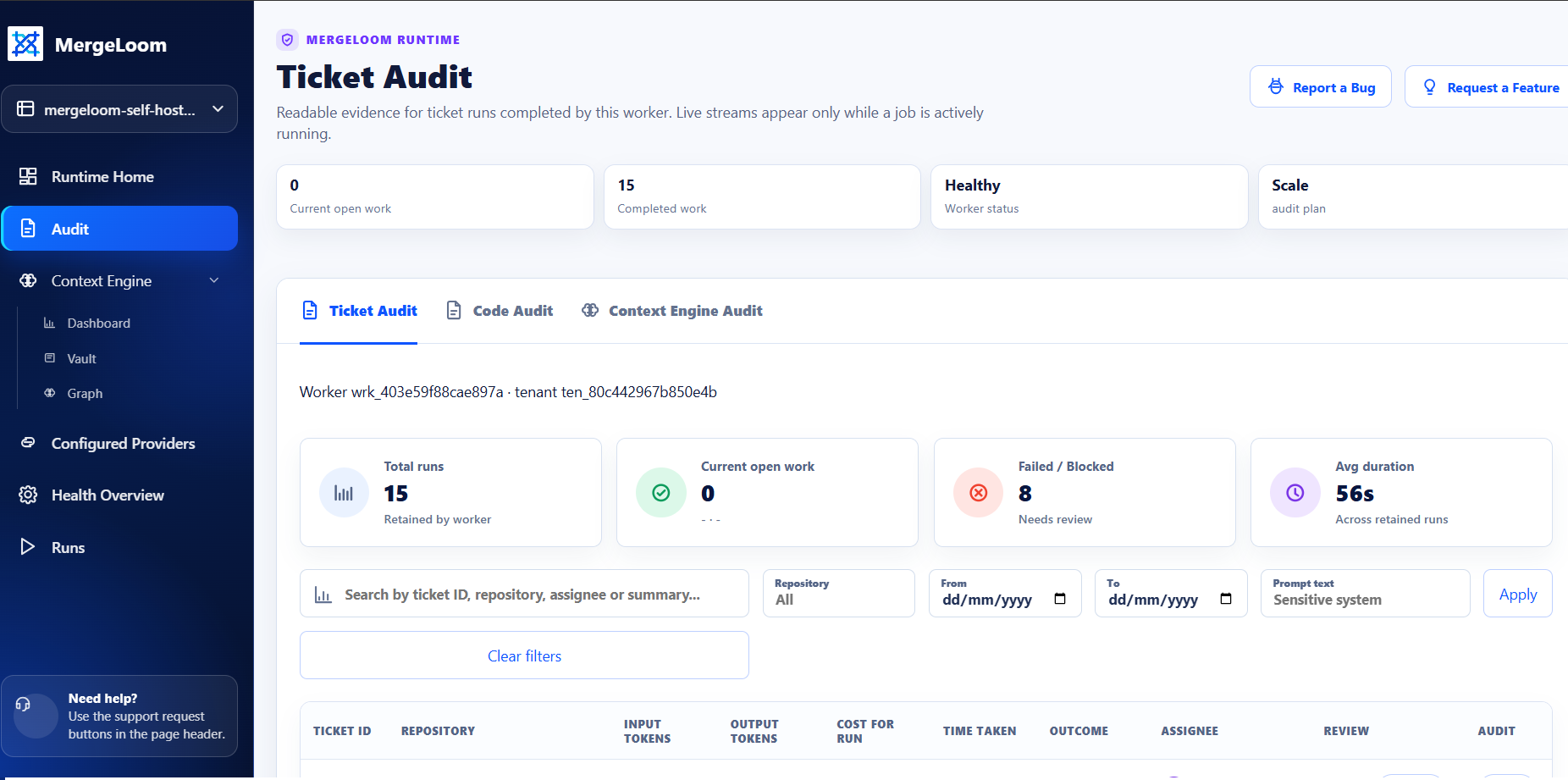
Self Hosted makes the boundary clear: your worker handles sensitive execution while the controller keeps the workflow moving.
Checkout, context assembly, provider calls, validation, repair, and branch prep happen on the worker.
The controller handles intake, routing, queue state, integration state, and PR/MR metadata.
Operators define which commands the worker runs during validation.
Back up the worker data volume when worker-local Code Audit evidence must survive host replacement.
Choose Self Hosted when security, network, provider, or compliance requirements make customer-operated execution the right path.
Keep sensitive checkout and traces inside customer infrastructure.
Use approved provider paths, private endpoints, or cloud workload identity.
Run validation where private packages, services, and secrets already exist.
Use Kubernetes Secrets, Docker secrets, or workload identity instead of vendor-held keys.
Keep execution detail and Code Audit evidence on the worker side.
Operate the worker as part of your normal platform runtime.
Checkout, context assembly, provider calls, validation, repair attempts, branch preparation, worker-local traces, Ticket Audit, and Code Audit.
The controller coordinates intake, routing, queue state, integration setup, and PR/MR workflow metadata.
Supported paths include Codex CLI, Claude Code CLI, OpenAI-compatible tool-calling endpoints, Vertex AI, AWS Bedrock, and Azure Foundry.
No. Cloud Hosted is faster to start. Self Hosted is better when runtime boundary, provider control, and local evidence ownership matter.
Run MergeLoom on scoped work before rolling it out. You only pay when a run opens a PR/MR for review, not for seats or tickets that stop before handoff.
Cloud
Then From £4 Per PR/MR
Self Hosted
Then From £2 Per PR/MR
Paid Outcomes
No PR/MR, No Run Charge
No PR/MR, No Run Charge · No Seat Pricing · Human Review Stays In Control