
AI-generated code can create a subtle review problem. The pull request may look complete, but the reviewer has less confidence in the reasoning behind it. Did the agent understand the ticket? Did it touch too many files? Did it run tests? Did it invent behavior because the context was thin?
This checklist gives reviewers a fast, repeatable way to inspect AI-assisted PRs without starting from suspicion every time.
1. Scope Match
Start with the ticket, not the code. The first review question is whether the branch did the requested work and stopped there.
Check:
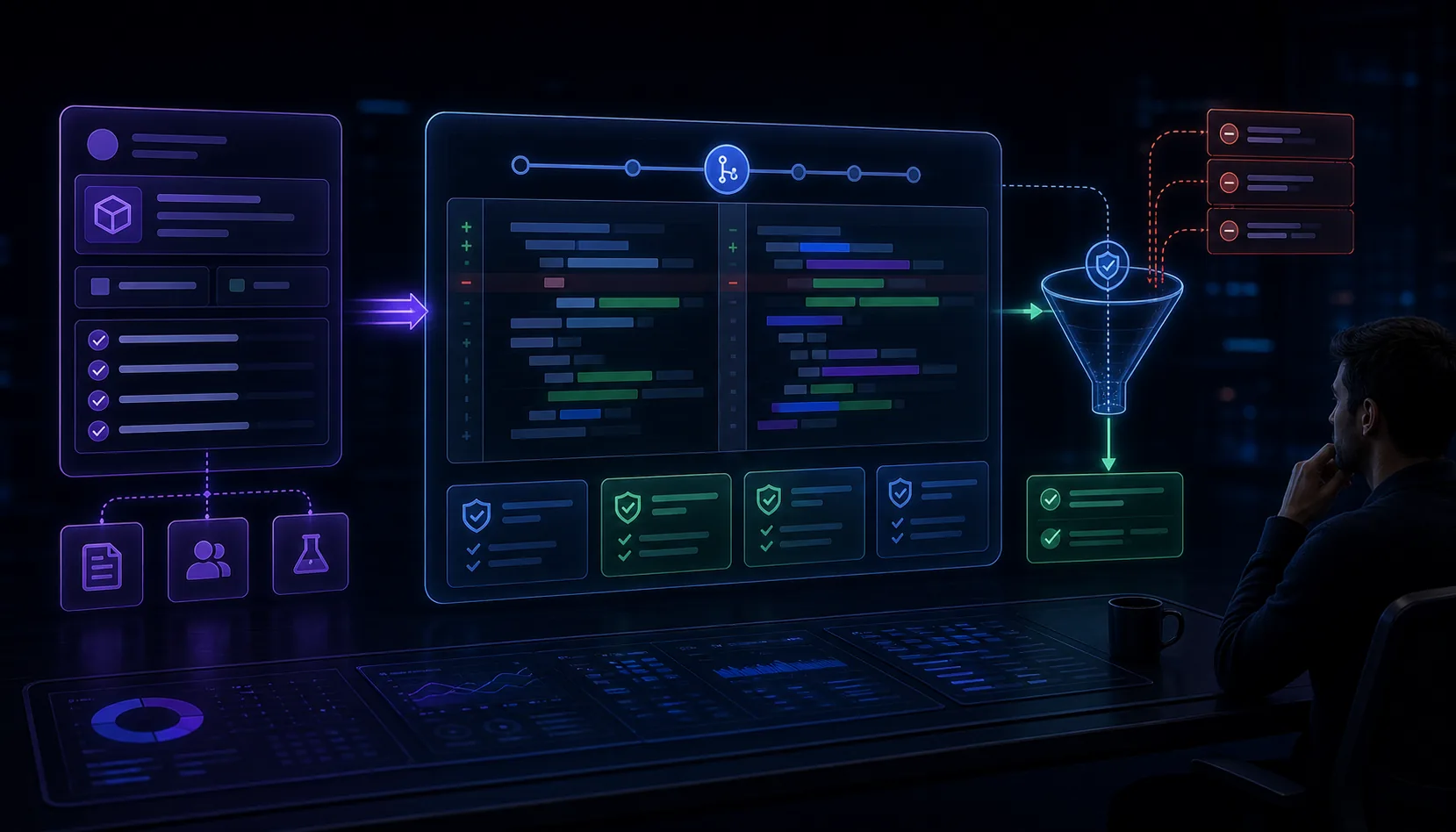
- Does the PR/MR link to the source ticket or issue?
- Are the acceptance criteria visible in the PR/MR summary?
- Do changed files map to the stated scope?
- Did the agent make unrelated cleanup, refactors, dependency changes, or formatting sweeps?
- Is any behavior added that was not requested?
If the answer is unclear, request changes. AI-generated PRs should be narrower than average, not broader.
2. Context Fit
AI agents often fail when they miss local conventions. Review whether the change fits the codebase around it.
Look for:
- naming that matches nearby code
- framework patterns already used in the repository
- existing helper APIs reused instead of duplicated
- error handling consistent with the surrounding module
- tests placed beside the right existing tests
- no invented configuration keys, routes, env vars, or product concepts
This is where human judgment still matters. Automated review can catch many mechanical issues, but architecture fit is usually contextual.
3. Validation Evidence
Do not accept “looks good” as proof. The PR/MR should show which checks ran.
Minimum evidence:
| Evidence | Reviewer Question |
|---|---|
| Lint/type check | Did the branch satisfy the repository’s static checks? |
| Targeted tests | Did the changed behavior run through a relevant test? |
| Build | Does the affected package/app still build? |
| Failed checks | Are failures explained rather than hidden? |
| Repair attempts | Did the agent make bounded fixes or widen scope? |
If the branch cannot run validation, the PR/MR should say why. The reviewer can then decide whether that gap is acceptable.
4. Security and Data Risk
AI-generated code deserves the same security review as human code, with extra attention to hallucinated dependencies and unsafe defaults.
Check:
- new dependencies and their maintenance/security posture
- auth, permission, and tenancy logic
- input validation and output encoding
- secrets, tokens, credentials, and logging
- network calls and third-party endpoints
- database queries, migrations, and data retention
- unsafe use of generated regex, shell commands, or deserialization

If the PR/MR touches sensitive code, raise the review bar. “AI generated” is not a risk category by itself, but it can hide weak assumptions behind polished-looking code.
5. Test Quality
AI can generate tests that pass without proving the real behavior. Review the tests as carefully as the implementation.
Ask:
- Do the tests fail against the old behavior?
- Do they assert business behavior, not implementation details?
- Are edge cases covered?
- Do test names explain the scenario?
- Did the agent remove or weaken existing tests?
For high-value changes, ask for a red-green signal. A generated test that never failed may only document the generated implementation.
6. Diff Size and Review Cost
Large AI diffs are expensive to review. Set expectations before rollout.
Useful guidelines:
- Small bug fix: usually one focused module plus tests.
- Test coverage task: implementation should not change unless the ticket says so.
- Refactor: must include an explicit behavior-preservation strategy.
- Feature work: should map cleanly to acceptance criteria and avoid side quests.
MergeLoom’s Diff Guard and Quality Agents are designed for this kind of pre-review control: detect wide diffs, run validation, and preserve evidence before human review.
7. PR/MR Summary Quality
The PR/MR description should help the reviewer. It should not be a generic agent log.
Useful summary format:
- Ticket: source ticket or issue.
- What changed: concise implementation summary.
- Why: acceptance criteria or user problem.
- Validation: commands run and outcomes.
- Risk: known risky areas, limitations, or manual checks.
- Reviewer focus: where human judgment is most needed.
If the summary does not make the change easier to review, it is noise.
8. Final Human Decision
AI review tools can comment, summarize, and flag issues. They should not replace merge ownership.
Before approval, a human reviewer should be able to say:
- The change matches the ticket.
- The implementation fits the codebase.
- Tests and validation evidence are acceptable.
- Security and data risks have been considered.
- The diff is reviewable and scoped.
- Any unresolved risk is visible in the PR/MR.
That is the standard for AI-generated code: not distrust, but evidence.
Copy-Paste Review Checklist
Use this in your PR/MR template:
- Ticket linked and acceptance criteria visible.
- Changed files match ticket scope.
- No unrelated refactor, formatting sweep, or dependency change.
- Implementation follows local patterns.
- Validation commands listed with results.
- Tests prove the requested behavior.
- Security, auth, data, and dependency risks checked.
- Diff size is reviewable.
- Known gaps are disclosed.
- Human reviewer retains merge approval.
FAQ
Question: Should every AI-generated PR/MR require a senior reviewer?
Short answer: Not always. Route by risk. Low-risk docs or tests can use normal review, while auth, billing, data, and architecture work should get senior review.
Question: Can AI code review tools approve AI-generated code?
Short answer: They can assist, but final approval should stay with a human reviewer under your normal branch protection rules.
Question: What is the fastest way to reduce AI PR review fatigue?
Short answer: Require validation evidence, diff-size discipline, and a ticket-linked summary before the PR/MR reaches reviewers.