
Devin has pushed AI coding from assistant tooling toward autonomous software work. Cognition’s official docs describe Devin as an autonomous AI software engineer that can write, run, and test code, with use cases that include Jira and Linear tickets, bugs, refactors, tests, and documentation.
That validates the buyer problem. Engineering leaders want more delivery capacity without losing control of how software changes move through tickets, repositories, checks, and review.
The comparison with MergeLoom is not about whether Devin is useful. It is about where the enterprise control layer should live. Devin gives teams an AI software engineering environment. MergeLoom focuses on turning approved work into controlled PRs and MRs inside the systems the team already uses.
What Devin Brings
Devin is built around delegated software work. Its official introduction describes tasks such as implementing features, fixing bugs, writing tests, maintaining docs, running refactors, and working from Linear or Jira tickets. The product includes an interface where users can follow activity, inspect the shell, use an embedded IDE, and take over when needed.
For enterprise teams, Devin Enterprise also includes admin and access concepts. The enterprise getting started guide covers organizations, roles, SSO, source code access, and integrations with tools such as GitHub, GitLab, Bitbucket, Azure DevOps, Slack, and Microsoft Teams.
The Enterprise Question Is Control
Once an AI agent can perform real engineering work, the hard questions become operational:
- Which tickets are approved for autonomous execution?
- Which repositories can the agent access?
- What context is trusted and current?
- What validation must run before a reviewer is asked to look?
- What happens when validation fails?
- Which evidence is attached to the PR or MR?
- How is cost tied to accepted outcomes rather than sessions?
- How do audit teams reconstruct what happened later?
Those questions are not objections to Devin. They are the normal requirements that appear when agentic work moves from individual adoption into engineering operations.
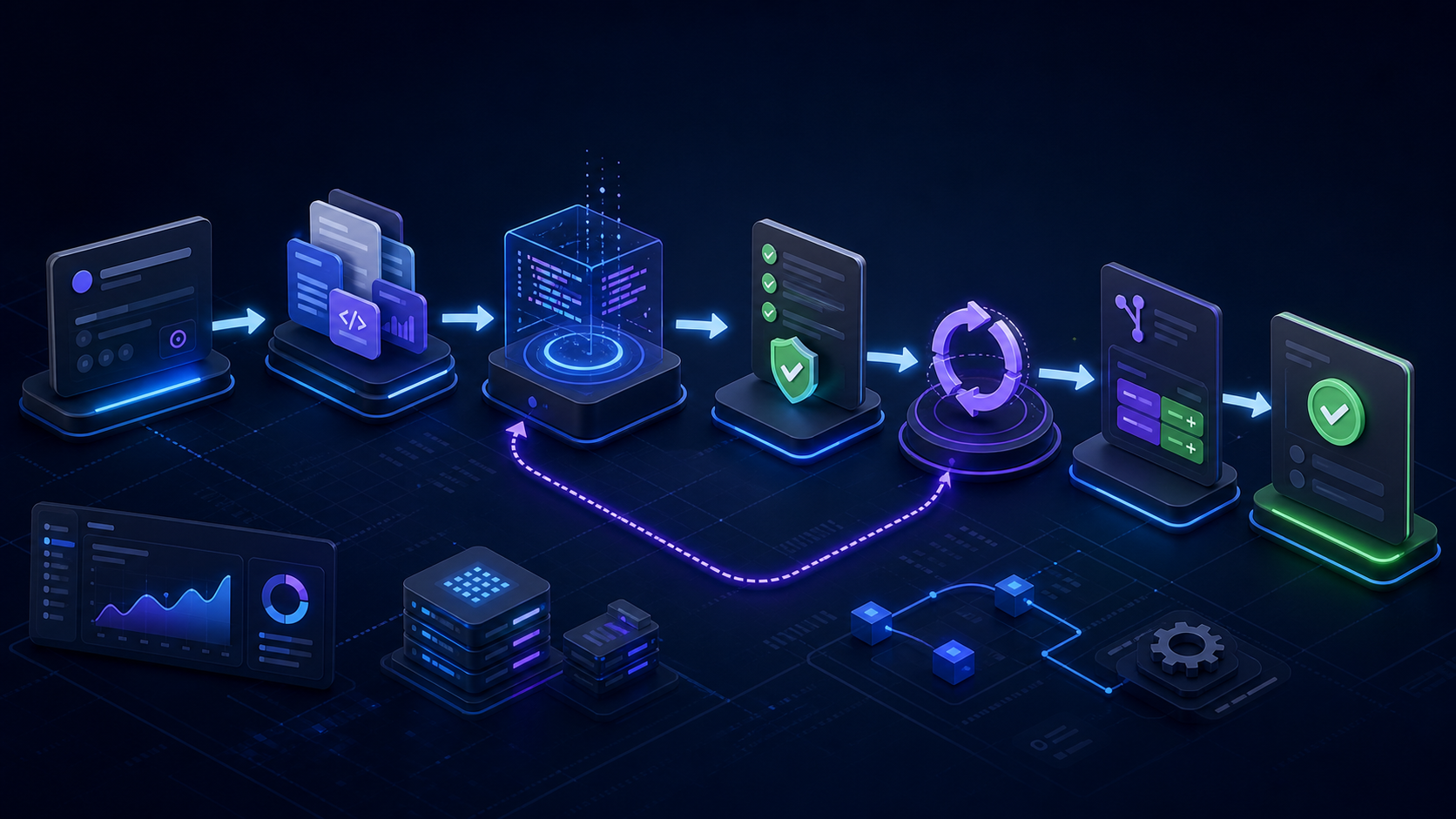
MergeLoom is built around those requirements. Its ticket-to-code automation uses the ticket as the unit of work, attaches approved context, runs validation, and prepares a PR or MR for review.
Start From Approved Tickets
Many AI coding rollouts begin with prompts. A developer asks an agent to fix something, hands it context, and iterates until the branch is ready.
That can work for individual productivity. It is harder to govern across teams because the original intent may live in chat history, local notes, or an agent session rather than the work tracker.
MergeLoom starts from approved tickets instead. A ticket carries business intent, acceptance criteria, status, priority, and the review expectation. That makes the source of work visible before execution starts.
For teams using Jira, GitHub Issues, GitLab Issues, monday.dev, Linear, Azure Boards, or Azure DevOps Repositories, this matters. AI coding should fit the delivery system, not create a parallel queue that engineering managers have to reconcile later.
Reusable Context Beats Repeated Discovery
Autonomous agents need context. They need repository rules, architectural boundaries, validation commands, conventions, API relationships, and product intent.
If every run rediscovers that context from scratch, teams pay twice. They pay in model and runtime cost, and they pay in review risk when the agent uses incomplete or stale assumptions.
MergeLoom’s Context Engine addresses that by making repository and documentation context reusable across runs. The goal is not to replace judgment. It is to give every approved run the same baseline knowledge before code changes begin.
A strong agent can still produce inconsistent results if the surrounding context is ad hoc.
Validate Before Review
AI generated code should not reach reviewers as a raw experiment. Reviewers need to know what was checked.
At minimum, enterprise teams should define required commands by repository:
- formatting and lint checks
- type checks
- unit and integration tests
- build commands
- security or dependency checks where relevant
- custom project validation scripts
MergeLoom’s Quality Agents run clarity checks, investigation, validation, bounded repair, review, and Diff Guard before handoff. When checks fail, the workflow should either repair within scope or stop with evidence instead of passing review debt to humans.
The agent may write the branch, but the workflow determines whether the branch is ready to review.
Audit Trails And Outcome Cost
Enterprise AI coding cannot be measured only by usage. A team can have many agent sessions and still create review churn.
Useful metrics include:
- approved tickets delegated
- runs stopped before code
- PRs and MRs opened
- validation pass and failure rates
- repair attempts
- review rework
- merged outcomes
- cost per accepted PR or MR
MergeLoom’s audit trails and attribution connect a run back to the ticket, context, commands, validation output, branch, and review handoff. That gives engineering leaders a delivery record, not just an AI activity log.
Where Each Fits
Devin may be a strong fit when a team wants a dedicated autonomous software engineering environment, wants developers to delegate and supervise work directly, and is comfortable managing the operational model around that environment.
MergeLoom is a better fit when the work has to stay inside an existing delivery process:
- tickets remain the source of approved work
- repository rules and context need to be reusable
- validation must happen before PR/MR review
- human reviewers keep merge authority
- audit evidence needs to survive beyond the session
- leadership wants to measure cost per accepted outcome
For sensitive environments, MergeLoom also supports a self-hosted AI coding infrastructure model so execution can stay inside the customer’s boundary while still producing normal PRs and MRs.

Bottom Line
Devin is a serious signal that autonomous software engineering is moving into enterprise software delivery. MergeLoom takes a different position: it is the workflow layer around approved tickets, controlled execution, validation evidence, and human review.
If your team is comparing Devin alternatives because you need more control around AI coding, start with Ticket-To-Code Automation or book a MergeLoom demo to map the workflow against your current delivery process.
Disclaimer: Devin is a product of Cognition. MergeLoom is not affiliated with Cognition or Devin.