
If you are comparing OpenHands alternatives, you are probably not just looking for an AI agent that can write code. You are looking for a practical way to make AI coding work inside real software delivery: tickets, repositories, validation, approvals, and review.
OpenHands gives teams an AI coding agent platform. MergeLoom focuses on turning existing enterprise tickets into PRs or MRs with validation evidence without changing the surrounding workflow.
What Is OpenHands?
OpenHands is an AI-driven development platform used to run coding agents against real repositories. It presents itself as supporting multiple ways to operate and deploy, including Cloud and Enterprise options, a CLI, an SDK, a local GUI, and integrations. For official references, see the OpenHands docs and the OpenHands GitHub repository.
OpenHands can help with common engineering tasks such as:
- implementing coding tasks and small features
- debugging and fixing bugs
- writing or updating tests
- exploring a repository and proposing changes
- supporting code review workflows, such as preparing diffs and rationale
Where OpenHands Works Well
OpenHands tends to be a strong fit when your team wants an AI coding agent environment and is comfortable shaping the agent workflow:
- Clear coding tasks: well-scoped changes with clean acceptance criteria.
- Repetitive engineering tasks: refactors, test updates, small fixes, and routine code changes.
- Developer-led AI coding: engineers driving the agent, iterating, and reviewing results.
- Teams comfortable building a custom agent workflow: platform teams that want to invest in agent configuration, tooling, and guardrails.
The Gap Enterprises Still Need to Solve
For many enterprise teams, the hard part is not running an AI coding agent. It is operationalizing enterprise AI coding inside the systems they already use without creating a disconnected side workflow.
Typical enterprise requirements include:
- Existing tickets and workflow systems: Jira, GitHub Issues, GitLab Issues, monday.dev, Linear, Azure Boards, and similar tools.
- Statuses, labels, queues, and approvals: work should move through the same controlled process.
- Repository-specific rules: branch policies, CODEOWNERS, linting, and security checks.
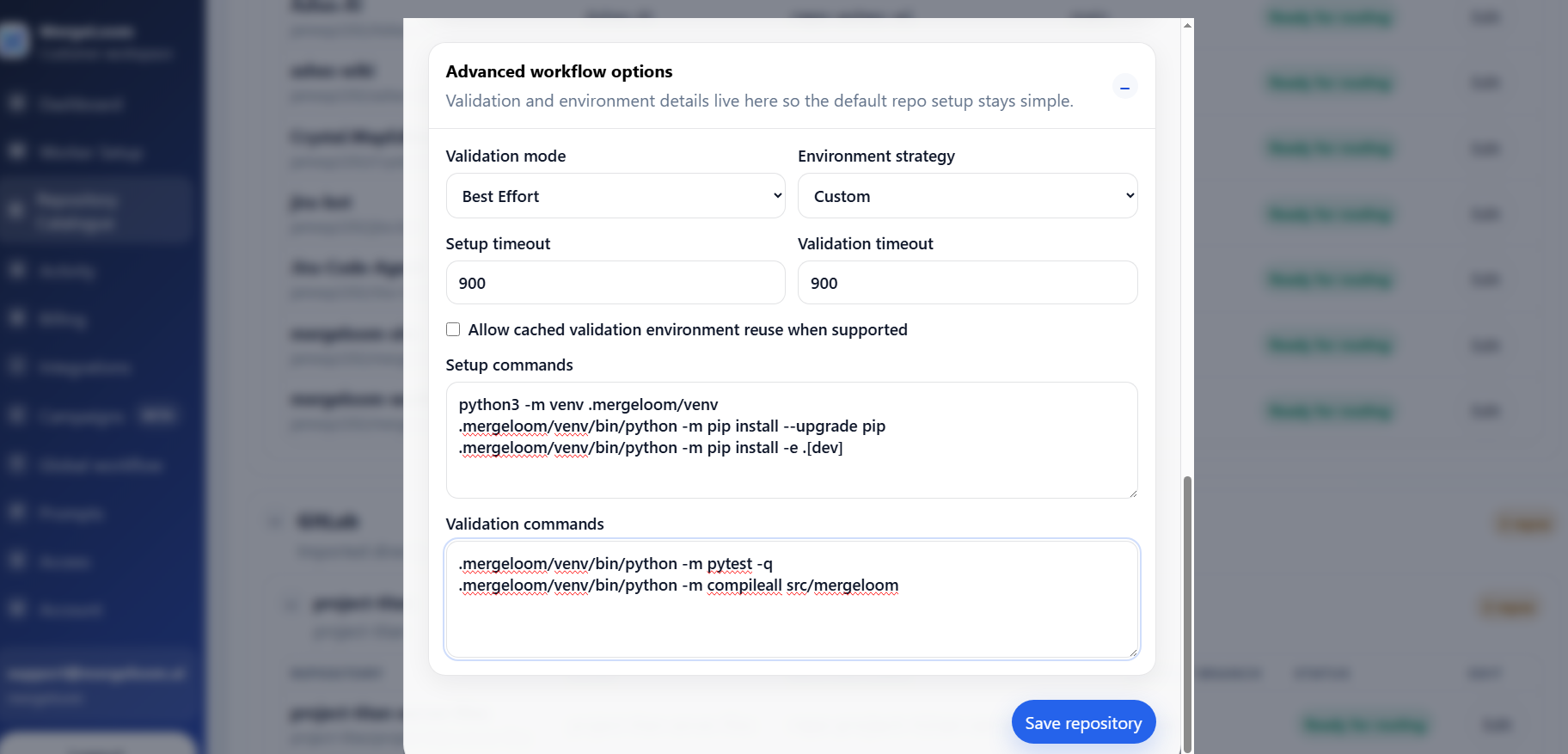
- Tests and validation: CI execution before anything becomes ready for review.
- Audit trails: traces of what ran, when, with what inputs and outputs.
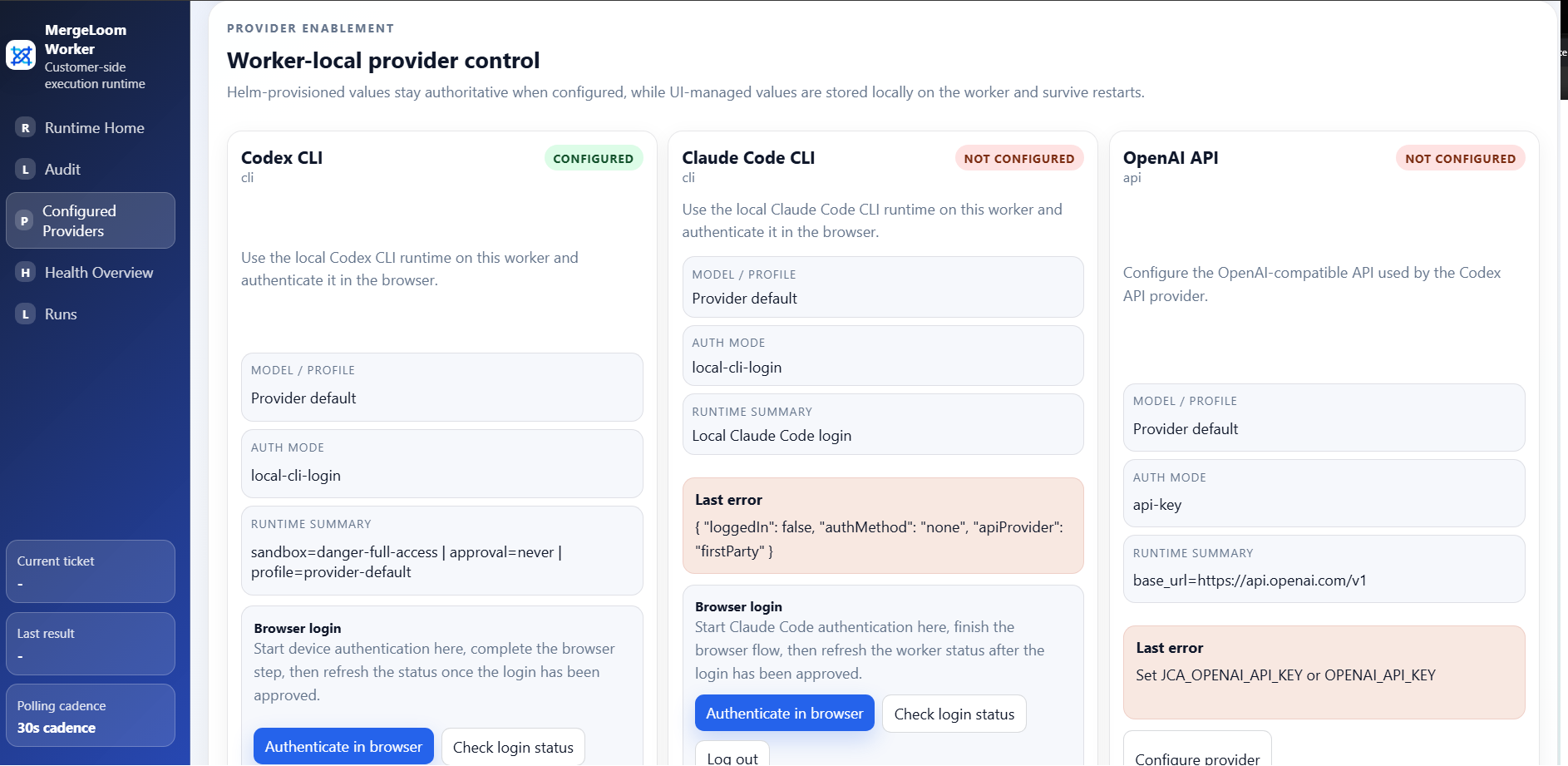
- AI provider choice: vendor-neutral AI coding to avoid lock-in.
- Human review in the loop: AI prepares the change; humans approve and merge.
- Cost control: predictable controlled runs instead of open-ended experimentation.
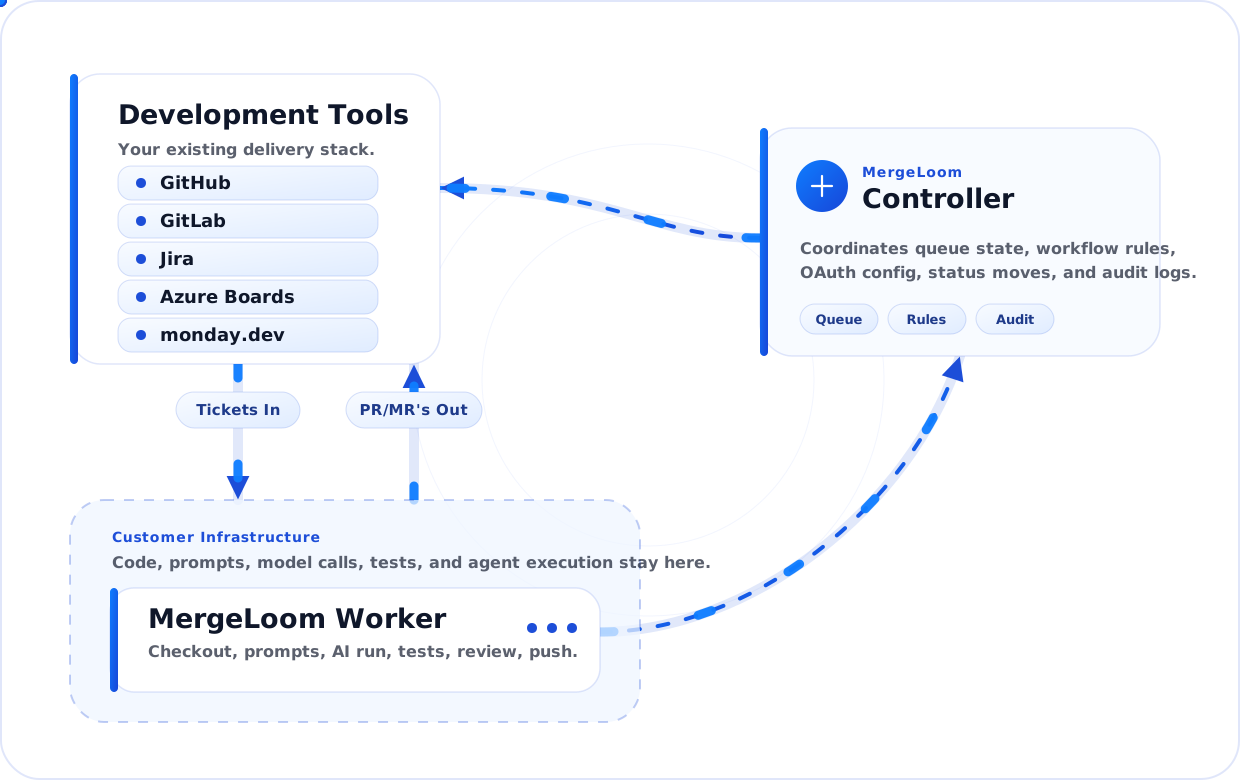
This is the space MergeLoom targets directly: a controlled ticket-to-code automation workflow that connects tickets to code changes, validation, and PR/MR handoff.
The Real Enterprise Cost Is Ticket-to-Code Handoff
The real enterprise cost is not just AI model usage. It is the time spent moving work from ticket to context, from context to code, from code to validation, and from validation to review.
MergeLoom reduces that handoff cost by making the ticket itself the starting point for a controlled coding run.
OpenHands vs MergeLoom: What Is Different for Enterprise Teams?
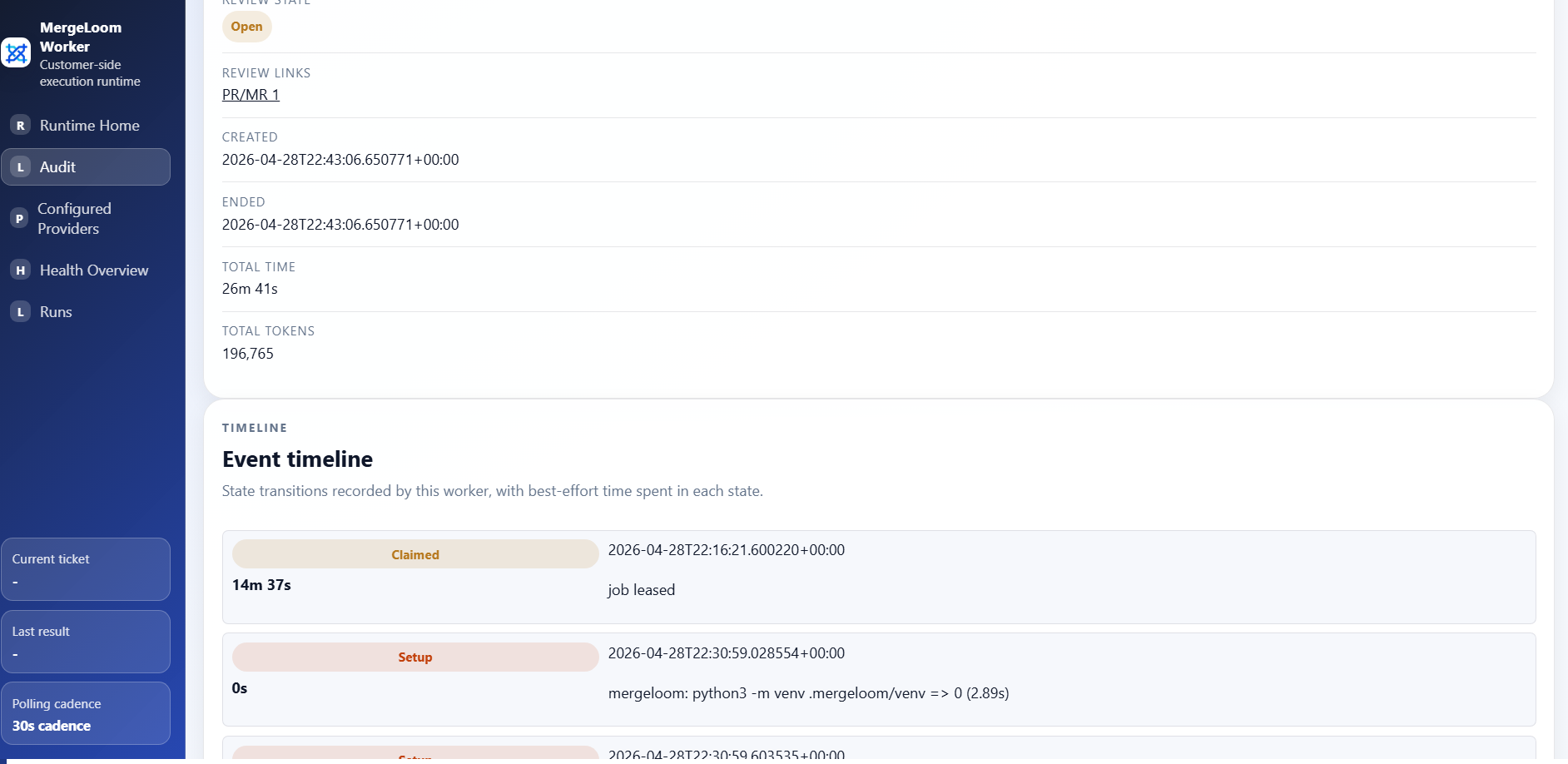
Both tools can be part of an AI coding strategy, but they optimize for different outcomes. OpenHands provides an agent platform. MergeLoom is built to orchestrate enterprise ticket execution end to end so work can move from ticket to PR/MR with validation evidence without changing how your team already ships software.
If your shortlist also includes AI review products, see the CodeRabbit alternative comparison for how MergeLoom positions AI-powered review inside a governed ticket-to-code workflow.
| Category | OpenHands | MergeLoom |
|---|---|---|
| Primary use case | AI coding agent platform to run and extend agents. | Enterprise ticket-to-code automation that produces PRs/MRs with validation evidence. |
| Workflow model | Developer or agent-driven tasks; workflow depends on your setup. | Workflow-native orchestration around existing ticket states, rules, and handoffs. |
| Ticket integration | Supported via integrations and team implementation choices. | Designed to start from existing tickets and produce PR/MR handoffs. |
| Enterprise adoption | Strong option for teams willing to engineer their agent workflow and governance. | Built for enterprises that want controlled execution without changing delivery process. |
| AI vendor choice | Configurable depending on deployment and integrations. | Vendor-neutral AI provider choice by design. |
| Hosting and control | Flexible, including self-hosted options, depending on deployment. | Customer-hosted execution: the worker runs inside your environment. |
| Validation and review | Can run tests; review process depends on how you wire it into your workflow. | Built around whole-system context assembly, validation, repository rules, PR/MR creation, and human review. |
| Cost positioning | Cost depends on usage patterns, operations, and handoff management. | Focus on lower ticket execution cost by reducing handoffs and standardizing controlled runs. |
| Best fit | Teams that want an open agent platform and will build the surrounding workflow. | Teams that want AI coding operationalized inside existing enterprise delivery workflows. |
Why MergeLoom Is Better for Enterprise Ticket-to-Code Automation
If your organization already runs on tickets, repositories, and CI, MergeLoom is designed to connect those pieces into one controlled system without asking teams to abandon existing tools or process.
- Lower development ticket execution cost: automate checkout, context assembly, AI execution, validation, and review request preparation, then keep human review in place.
- Vendor-neutral AI provider choice: use the AI provider and model your enterprise approves instead of locking the workflow to one model vendor.
- Customer-hosted worker: execution happens inside your environment.
- Guardrails, validation, and auditability: repository rules, repeatable system context, tests, validation, and traceable runs.
- Human review stays in the loop: MergeLoom prepares changes with validation evidence; engineers approve and merge.
Practically, this means Jira AI coding and GitHub AI coding do not have to become separate tools and separate habits. The ticket remains the unit of work, and the PR or MR remains the controlled handoff point.
When to Choose OpenHands
OpenHands is a good choice when:
- you want an open-source AI agent framework to experiment with or extend
- developers want a local or CLI coding agent experience
- your team wants to build custom agent infrastructure, integrations, and governance
If the comparison is really between a local agent board and a governed delivery workflow, the Vibe Kanban alternative page is the closer fit. If your buying question is more about AI adoption analytics, model routing, and cost visibility, see the Beezi AI alternative comparison.
When to Choose MergeLoom as an OpenHands Alternative
MergeLoom is a better fit when:
- you already use Jira, GitHub, GitLab, monday.dev, Linear, Azure Boards, or Azure DevOps Repositories and want AI to fit that workflow
- your enterprise already has AI access but needs workflow orchestration and control
- you want ticket-to-code automation, not just an agent interface
- you need controlled, repeatable, auditable AI coding with repository-level rules and validation
- you want lower ticket delivery cost without changing how tickets, labels, statuses, and reviews work
Conclusion: OpenHands vs MergeLoom Is Really About Workflow
The question is not whether OpenHands is useful. The question is whether your team needs an AI coding agent platform, or a controlled system that turns existing tickets into reviewed code changes inside your enterprise workflow.
If you want to stop treating AI coding as a disconnected side workflow and instead operationalize it across tickets, repositories, tests, and human review, MergeLoom is built for that job.
Want to turn existing tickets into PRs and MRs with validation evidence without changing your workflow? Start with MergeLoom or request a walkthrough.
Disclaimer: OpenHands is a project/product of its respective owners. MergeLoom is not affiliated with OpenHands.
FAQ: OpenHands and MergeLoom
What is OpenHands?
OpenHands is an AI-driven development platform used to run coding agents against real repositories, with multiple operating options including local and managed deployments.
Is MergeLoom an OpenHands alternative?
For enterprises evaluating OpenHands for delivery automation, MergeLoom is an alternative focused on controlled, workflow-native ticket-to-code execution.
How is MergeLoom different from OpenHands?
OpenHands is an agent platform. MergeLoom orchestrates ticket-to-code automation: ticket intake, whole-system context assembly, execution, validation, and PR/MR handoff with auditability and human review.
Can MergeLoom work with existing Jira or GitHub workflows?
Yes. MergeLoom is designed to fit around existing ticketing and source control workflows so teams do not need to change how they manage statuses, labels, branches, and reviews.
Does MergeLoom lock teams into one AI model?
No. MergeLoom supports vendor-neutral AI provider choice so teams can use approved models and endpoints.
Is MergeLoom suitable for enterprises?
Yes. MergeLoom is built for enterprise control: customer-hosted execution, repository rules, validation, audit trails, and human review in the loop.