
AI coding tools can produce code quickly. They can also produce code that looks plausible but fails tests, ignores local conventions, changes too much, or leaves reviewers with cleanup.
That is why validation before PR/MR handoff matters.
The goal is not to prove AI output is perfect. The goal is to catch obvious failures before human reviewers spend time.
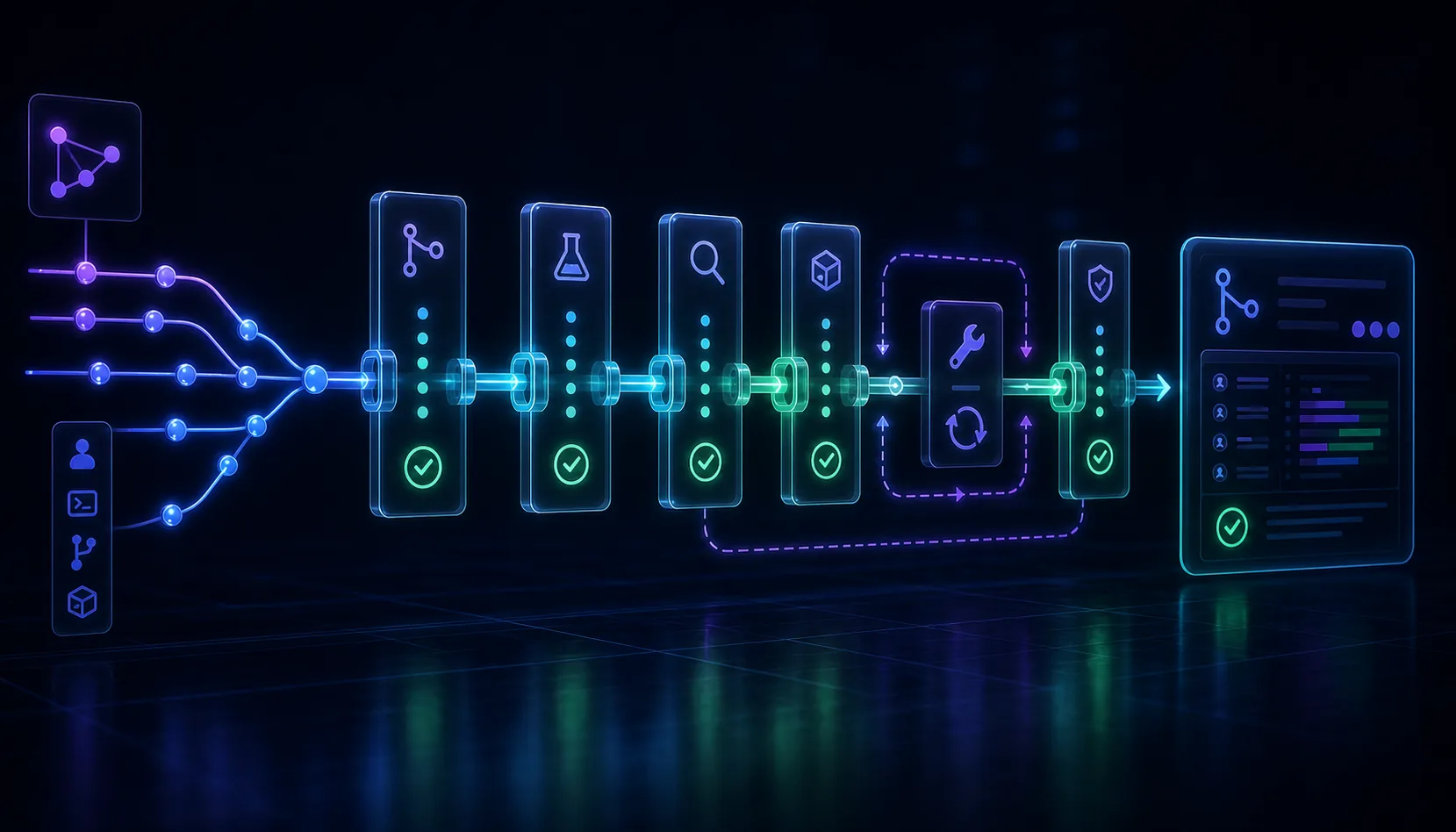
What Pre-Review Validation Means
Pre-review validation is the set of checks that run after an AI coding agent changes code but before a PR/MR is presented as ready for human review.
It can include:
- install or setup commands
- format checks
- linting
- type checking
- unit tests
- targeted integration tests
- build commands
- custom repository policy checks
- diff size and scope checks
These checks should run before reviewers are asked to evaluate the branch.
Why PR-Time CI Is Not Enough
CI on a pull request is important. It should remain part of the workflow.
But if every AI-generated branch reaches review before basic checks run, reviewers still pay the setup cost:
- reading a weak summary
- checking whether the branch even builds
- finding missing tests
- asking for obvious fixes
- waiting for repeated correction cycles
Pre-review validation moves that cleanup earlier.
Build a Repository-Specific Validation Contract
Do not use one generic validation command for every repository.
Each repository should define:
- setup command
- test command
- lint command
- typecheck command
- build command
- custom checks
- known flaky commands
- commands that require special credentials
This contract should live close to the repository or in the orchestration platform. It should not be reinvented per prompt.
MergeLoom’s docs on repository rules and validation cover how validation commands fit into controlled runs.
Run the Cheapest Useful Checks First
Validation does not have to run every expensive command immediately.
A practical order:
- static checks and formatting
- type checks
- targeted tests for touched areas
- broader test or build commands
- custom risk checks
This avoids wasting long CI cycles on branches that fail a simple syntax or lint check.
Use Repair Loops Carefully
Repair loops can save time when the failure is clear and in scope.
Good repair targets:
- test failures caused by the change
- type errors
- lint failures
- missing imports
- broken snapshots where the expected behaviour is clear
Poor repair targets:
- ambiguous product behaviour
- security-sensitive design choices
- large architecture changes
- failures requiring new credentials or environment access
- repeated failures after bounded attempts
The repair loop should have limits. It should record what failed, what changed, and what passed afterwards.

Add Diff Guard
Validation is not only about commands. AI-generated code can pass tests and still be too broad.
Diff controls can check:
- changed-line budget
- unexpected files
- generated files
- lockfile changes
- high-risk directories
- public API changes
This is especially useful for small tickets where a large diff is itself a risk signal.
MergeLoom’s Quality Agents include Diff Guard as part of the pre-review path.
Make Validation Visible to Reviewers
The PR/MR should summarize:
- commands run
- pass/fail results
- repair attempts
- checks skipped and why
- known validation gaps
Do not bury this evidence in raw logs only. Reviewers need a concise packet and a link to detail.
Stop When Validation Cannot Prove Enough
Sometimes the correct outcome is to stop before PR/MR handoff.
Stop when:
- the ticket lacks acceptance criteria
- the repository cannot be identified
- required tests cannot run
- the agent needs secrets it should not have
- repair attempts keep failing
- the diff is too large for the approved scope
A stopped run with useful evidence is better than a weak PR/MR.
Metrics to Track
Track:
- validation pass rate
- failure causes
- repair success rate
- checks skipped
- time spent in repair
- review comments caused by missed validation
- merge rate after validated handoff
These metrics improve the workflow over time.
Where MergeLoom Fits
MergeLoom’s Quality Agents wrap every ticket-to-code run in clarity checks, investigation, validation, repair, specialist review, Diff Guard, and handoff evidence.
That means engineers receive a PR/MR with the validation story attached, rather than a raw AI-generated diff.

Start with Ticket-To-Code Automation or book a demo to map the validation commands that matter in your repositories.