
GitHub Copilot cloud agent is an important category signal. GitHub’s own documentation describes an agent that can research a repository, create a plan, make code changes on a branch, and optionally open a pull request.
For engineering leaders, that changes the adoption question. Copilot is no longer only about inline suggestions. It can participate in delivery work.

That creates a governance question: what needs to exist around the agent so the organisation can use it safely and productively?
What Copilot Coding Agent Changes
Traditional AI coding assistants help a developer work faster inside an IDE. The developer remains the session owner: they decide what to ask, what files to edit, which commands to run, when to commit, and when to open a PR.
Agentic coding moves more of that path into the background.
GitHub’s public docs say Copilot cloud agent can handle work such as bug fixes, incremental features, test coverage, documentation, technical debt, and merge conflicts. It can work in a GitHub Actions-powered environment and create branch changes for review.
That is useful because routine work can move without constant developer attention.
It also means the workflow needs controls.
The Governance Gap
Copilot can create or update code, but engineering leaders still need to answer:
- Which tickets are appropriate for delegation?
- Who can ask the agent to work?
- Which repositories are allowed?
- What context should the agent rely on?
- Which validation commands must run?
- What happens when checks fail?
- What evidence should reviewers see?
- How do we track cost and accepted outcomes?
- How do we audit agent activity across teams?
Those are not objections to Copilot. They are the operating requirements that show up when agentic coding moves into real software delivery.
Define Allowed Work Types
Start with a narrow delegation policy.
Good candidates:
- small bug fixes with clear reproduction steps
- test additions
- documentation updates
- minor configuration changes
- bounded refactors with existing tests
- maintenance work that already has a clear validation path
Avoid broad autonomy at the start.
Usually unsuitable for early rollout:
- authentication and authorization changes
- billing or payment logic
- data migrations
- security incident fixes
- large architecture changes
- work with unclear acceptance criteria
MergeLoom’s AI coding agent governance policy template gives teams a starting point for writing this down.
Start From Tickets, Not Loose Prompts
Agentic coding is easier to govern when work starts from approved tickets.
A ticket gives you:
- business intent
- acceptance criteria
- approval state
- priority
- repository routing hints
- review expectations
Loose prompts are harder to audit because intent is often spread across chat, local context, and memory.
MergeLoom’s ticket-to-code automation turns approved work into controlled runs so the source ticket stays attached to the resulting PR/MR.
Control Context Before Execution
Copilot can work from repository context, but teams still need a policy for trusted context.
Define:
- where repository instructions live
- which docs are approved for agent use
- which files or directories are excluded
- how architecture rules are maintained
- how stale or conflicting docs are handled
This is especially important in larger systems where the agent needs to understand APIs, service boundaries, validation commands, and ownership conventions.
MergeLoom’s Context Engine exists to make context reusable, controlled, and attached to the run record.
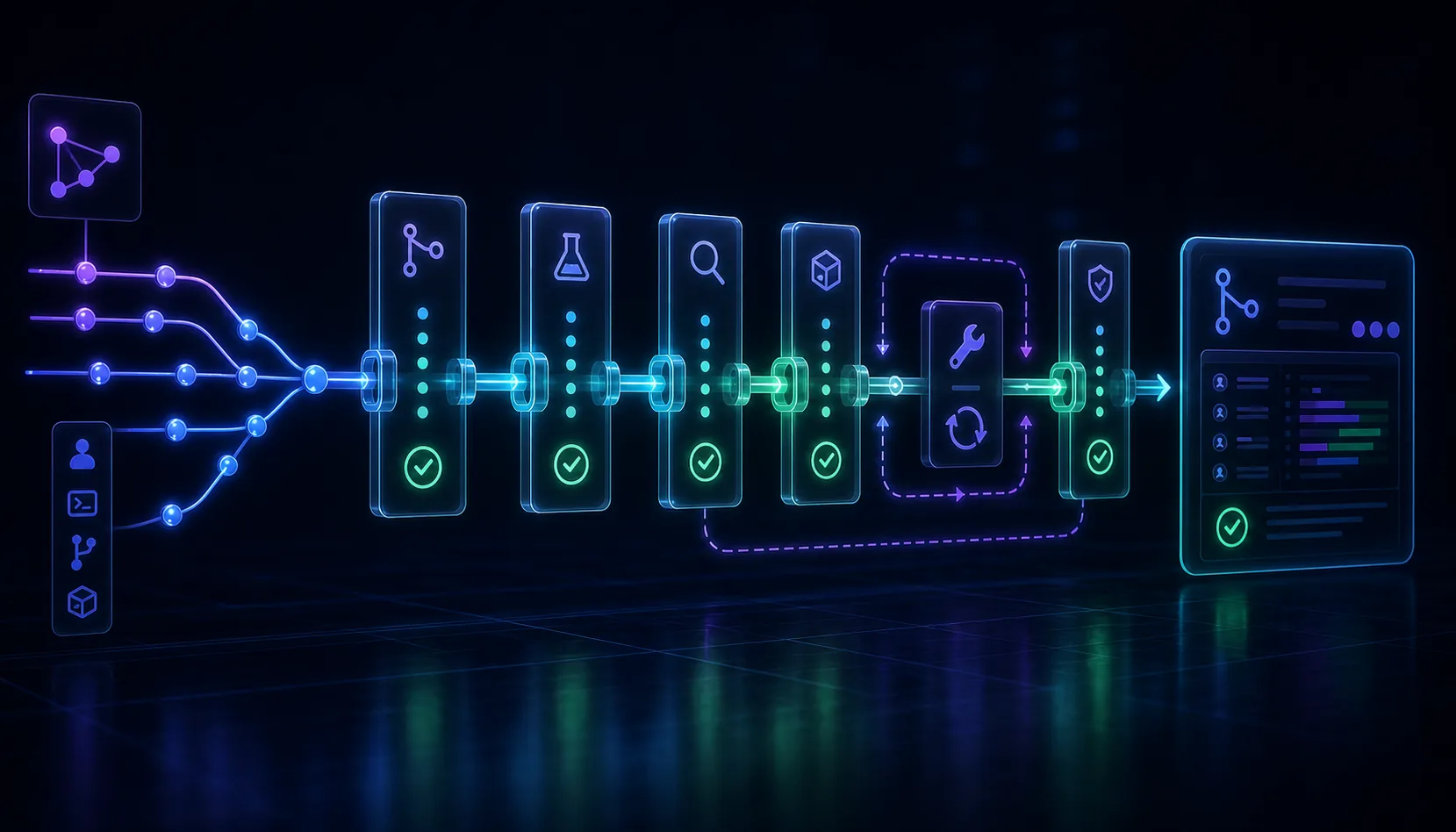
Require Validation Before Review
GitHub branch protection catches some problems after a PR exists. Governance is stronger when validation happens before reviewers are asked to spend time.
Require the agent workflow to run:
- lint or formatting checks
- type checks
- relevant tests
- build commands
- repository-specific validation scripts
If checks fail, the run should either repair the issue within scope or stop with evidence.
MergeLoom’s Quality Agents handle clarity checks, investigation, validation, repair, review, and Diff Guard before handoff.
Preserve Human Review
Agentic coding should improve review, not remove it.
Reviewers should receive:
- a clean PR/MR summary
- the source ticket
- acceptance criteria addressed
- commands run
- validation output
- known gaps
- reviewer focus areas
Humans still own product fit, architecture judgment, security risk, and merge approval. This remains true even when the agent produced most of the branch.
Audit Agentic Work
Copilot usage metrics can help teams measure pull request outcomes, but broader governance usually needs delivery evidence across the ticket-to-code path.
Track:
- ticket source
- who delegated the work
- context sources
- repository and branch
- files changed
- validation commands
- repair attempts
- review handoff
- final PR/MR outcome
MergeLoom’s audit trails are designed around this kind of run evidence.

Measure Accepted Outcomes
Do not evaluate the rollout only by number of agent sessions.
Measure:
- attempted runs
- runs stopped before coding
- PRs/MRs opened
- PRs/MRs merged
- review rework
- validation failure rate
- lead time from ticket approval to review
- cost per accepted PR/MR
These metrics tell you whether AI is improving delivery or just creating more review load.
Where MergeLoom Fits
MergeLoom does not require teams to reject Copilot or other AI coding tools. The category is moving toward AI agents that can prepare pull requests, and Copilot is one of the products proving it.
MergeLoom focuses on the workflow layer around AI coding:
- approved work intake
- context assembly
- controlled execution
- validation and repair
- PR/MR handoff
- audit evidence
- outcome cost visibility
If your team is adopting Copilot coding agent and needs an operating model around it, start with AI Code Governance Platform or book a MergeLoom demo to map the controls around your current GitHub workflow.